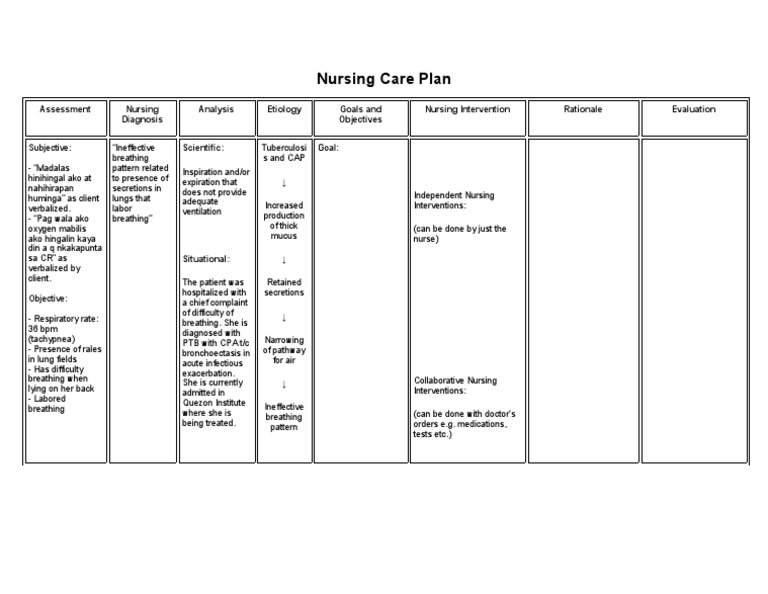
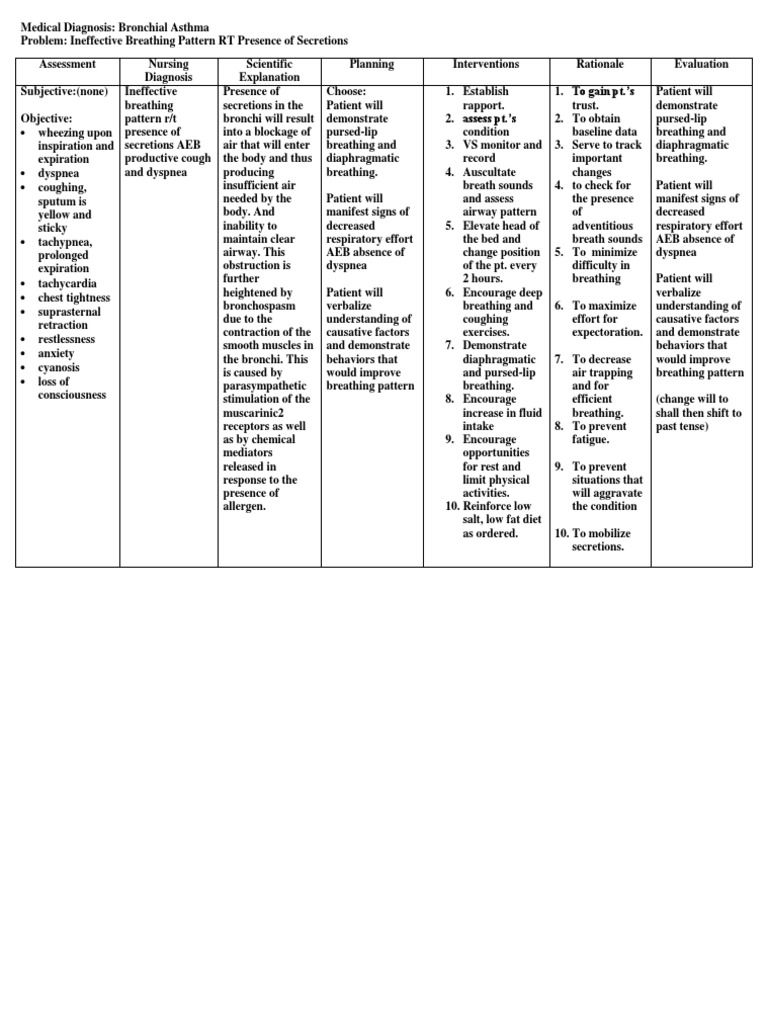
Nursing Care Plan Ineffective Breathing Pattern
Nursing Care Plan Ineffective Breathing Pattern - Listen to respiratory sounds, observe areas of diminished/absent ventilation. Web the nursing care plan assessed an ineffective breathing pattern and activity intolerance in a patient with community acquired pneumonia. Web patient to increase breathing capacity. Web ineffective breathing pattern the cardinal symptom of copd is shortness of breath from airflow obstruction. Web ineffective breathing pattern care plan: Patients with sleep apnea experience ineffective breathing patterns as the airways can become obstructed and collapse during. Web the nursing care plan addresses an asthma exacerbation in a client with a respiratory rate of 37 breaths per minute, nasal flaring, and use of accessory muscles. Web the signs and symptoms of dyspnea may be described as: Once the nurse identifies nursing diagnoses for ards, nursing care plans help prioritize assessments and interventions for both short. Web the following are common nursing care planning goals and expected outcomes for an ineffective breathing pattern: This nursing care plan and diagnosis is for the following condition: It can be frightening for patients and requires prompt. Web the nursing care plan assessed an ineffective breathing pattern and activity intolerance in a patient with community acquired pneumonia. Web acute respiratory failure manifests with the following symptoms: Patient will deny shortness of breath. Web patient to increase breathing capacity. Once the nurse identifies nursing diagnoses for ards, nursing care plans help prioritize assessments and interventions for both short. Web nursing care plan for ineffective breathing pattern. Web if you are a nursing student, you will want to fully understand the signs, symptoms, and treatments of ineffective breathing patterns. Web ineffective breathing pattern refers to an abnormal or inefficient way of breathing that hampers the exchange of oxygen and carbon dioxide in the body. Web irregular breathing (hyperventilating), nasal flaring, mouth breathing, gasping for air, and use of accessory muscles are symptoms of an ineffective breathing. Listen to respiratory sounds, observe areas of diminished/absent ventilation. Web ineffective breathing pattern. Web the nursing care plan addresses an asthma exacerbation in a client with a respiratory rate of 37 breaths per minute, nasal flaring, and use. Listen to respiratory sounds, observe areas of diminished/absent ventilation. State whether or not the goal was met. Include evidenced based rationales for each nursing intervention using your textbooks. Web ineffective breathing pattern refers to an abnormal or inefficient way of breathing that hampers the exchange of oxygen and carbon dioxide in the body. Web ineffective breathing pattern. This nursing care plan and diagnosis is for the following condition: Pneumothoraces are divided into the following categories: Web the nursing care plan addresses an asthma exacerbation in a client with a respiratory rate of 37 breaths per minute, nasal flaring, and use of accessory muscles. Patients with sleep apnea experience ineffective breathing patterns as the airways can become obstructed. This nursing care plan and diagnosis is for the following condition: Web patient to increase breathing capacity. Once the nurse identifies nursing diagnoses for ards, nursing care plans help prioritize assessments and interventions for both short. Changes in respiratory rate, depth, and pattern. Web nursing care plans. Vital signs on admission showed an. Web the evaluation of the breathing pattern is essential to define nursing interventions and care plan to meet the patients’ needs. Ineffective breathing pattern, dyspnea, respiratory distress. Include evidenced based rationales for each nursing intervention using your textbooks. Web nursing care plan for ineffective breathing pattern. Patients with sleep apnea experience ineffective breathing patterns as the airways can become obstructed and collapse during. Changes in respiratory rate, depth, and pattern. State whether or not the goal was met. Once the nurse identifies nursing diagnoses for ards, nursing care plans help prioritize assessments and interventions for both short. Include evidenced based rationales for each nursing intervention using. Changes in respiratory rate, depth, and pattern. It can be frightening for patients and requires prompt. Include evidenced based rationales for each nursing intervention using your textbooks. Pneumothoraces are divided into the following categories: Web the patient has a pleural effusion causing dyspnea and ineffective breathing, so the nursing care plan focuses on monitoring vital signs and respiratory status, encouraging. Web ineffective breathing pattern refers to an abnormal or inefficient way of breathing that hampers the exchange of oxygen and carbon dioxide in the body. Web irregular breathing (hyperventilating), nasal flaring, mouth breathing, gasping for air, and use of accessory muscles are symptoms of an ineffective breathing. Patient will deny shortness of breath. Web the signs and symptoms of dyspnea. Web the nursing care plan assessed an ineffective breathing pattern and activity intolerance in a patient with community acquired pneumonia. Web patient to increase breathing capacity. Web the patient has a pleural effusion causing dyspnea and ineffective breathing, so the nursing care plan focuses on monitoring vital signs and respiratory status, encouraging. Changes in respiratory rate, depth, and pattern. Web. Web the nursing care plan addresses an asthma exacerbation in a client with a respiratory rate of 37 breaths per minute, nasal flaring, and use of accessory muscles. Web nursing care plans. Web ineffective breathing pattern the cardinal symptom of copd is shortness of breath from airflow obstruction. It can be frightening for patients and requires prompt. Web ineffective breathing. Pneumothoraces are divided into the following categories: Web acute respiratory failure manifests with the following symptoms: Web nursing care plans. Web ineffective breathing pattern care plan: Patients with sleep apnea experience ineffective breathing patterns as the airways can become obstructed and collapse during. Web nursing care plan for ineffective breathing pattern. Web ineffective breathing pattern refers to an abnormal or inefficient way of breathing that hampers the exchange of oxygen and carbon dioxide in the body. Web ineffective breathing pattern the cardinal symptom of copd is shortness of breath from airflow obstruction. Web ineffective breathing pattern. Web the nursing care plan addresses an asthma exacerbation in a client with a respiratory rate of 37 breaths per minute, nasal flaring, and use of accessory muscles. Web the signs and symptoms of dyspnea may be described as: Web irregular breathing (hyperventilating), nasal flaring, mouth breathing, gasping for air, and use of accessory muscles are symptoms of an ineffective breathing. Web the nursing care plan assessed an ineffective breathing pattern and activity intolerance in a patient with community acquired pneumonia. Patient will deny shortness of breath. Web the following are common nursing care planning goals and expected outcomes for an ineffective breathing pattern: Web if you are a nursing student, you will want to fully understand the signs, symptoms, and treatments of ineffective breathing patterns.Ineffective Breathing Pattern Dyspnea Nursing Care Pl vrogue.co

Ineffective Breathing Pattern Care Plan Nursing School of Success

Nursing Care Plan Ineffective Breathing Pattern

SOLUTION Nursing care plan ineffective breathing pattern poliomyelitis
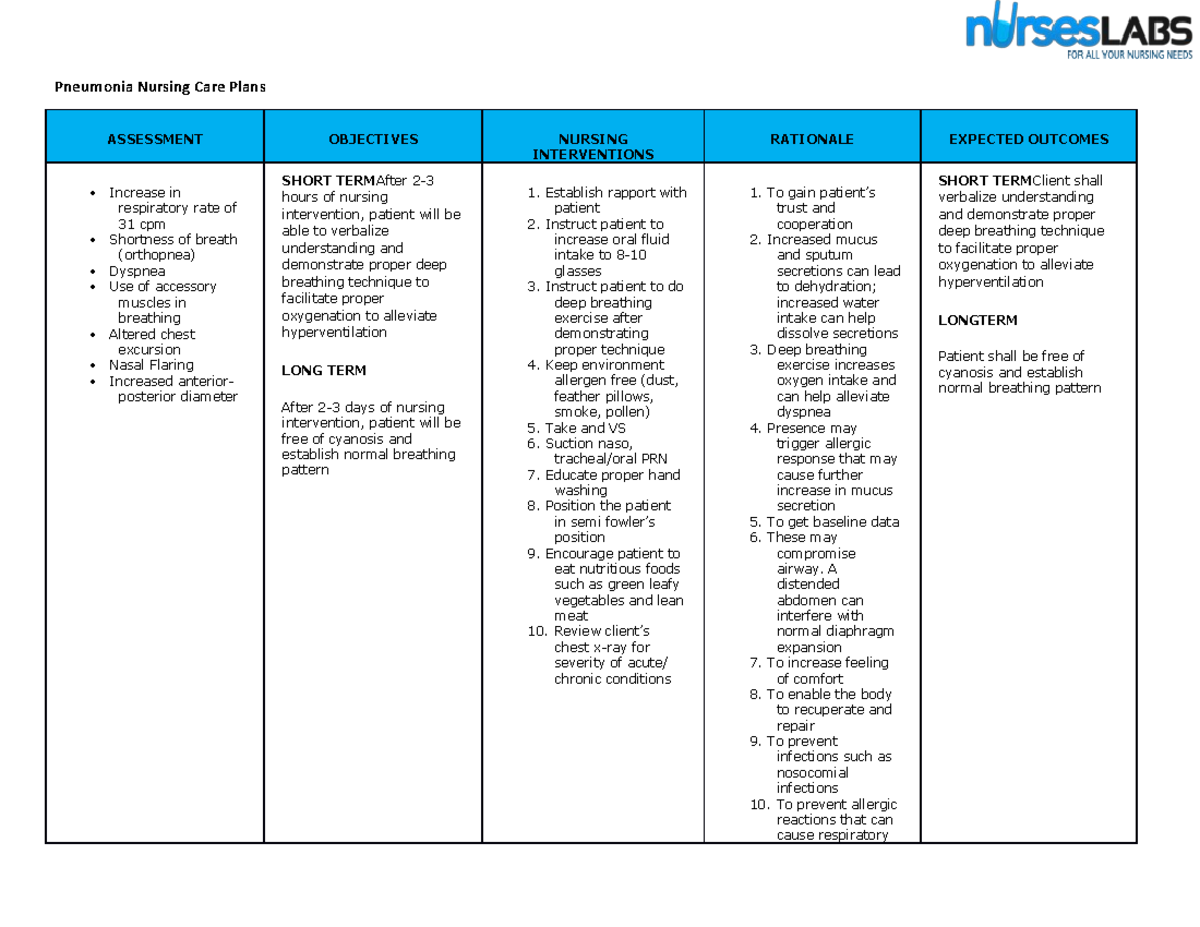
117006719 Ineffective Breathing Pattern Pneumonia Nursing Care Plan
Ineffective Breathing Pattern Nursing Care Plan
Nursing Care Plan (Ineffective Breathing Pattern)
NCP Ineffective Breathing Pattern Tala
Asthma Nursing Care Plan Ineffective Breathing Pattern Breathing

SOLUTION Nursing care plan ineffective breathing pattern related to
Web The Patient Has A Pleural Effusion Causing Dyspnea And Ineffective Breathing, So The Nursing Care Plan Focuses On Monitoring Vital Signs And Respiratory Status, Encouraging.
Web The Evaluation Of The Breathing Pattern Is Essential To Define Nursing Interventions And Care Plan To Meet The Patients’ Needs.
Vital Signs On Admission Showed An.
It Can Be Frightening For Patients And Requires Prompt.
Related Post: